
Why Do I Get Triggered So Easily?
Sep 06, 2026
What Your Triggers May Be Trying to Teach You
Have you ever wondered, Why do I get triggered so easily?
Maybe someone questions a decision you made, and suddenly you’re explaining yourself in exhausting detail.
Someone you love is disappointed, and you immediately feel guilty.
Your spouse sounds frustrated, and before you realize what’s happening, you’re defending yourself.
Someone doesn’t respond to your message, and your mind begins filling in the blanks.
Your child is upset, and you feel an overwhelming need to make everything okay.
Then later, after the intensity has passed, you wonder: Why did that affect me so much?
For a long time, I thought healing meant I would eventually stop getting triggered.
I imagined becoming so emotionally healthy that difficult conversations wouldn’t bother me anymore. I wouldn’t get defensive. I wouldn’t feel the urge to explain myself. I wouldn’t feel responsible when someone was disappointed in me. I wouldn’t shut down, get anxious, or feel that familiar urgency to make everything okay.
I would just be…healed.
But that isn’t what I’ve discovered.
What I’ve discovered is that some of the moments I most wanted to get rid of became the moments that taught me the most about myself.
Because a trigger can be more than an uncomfortable emotional reaction.
It can be information.
And what if the question isn’t simply: How do I stop getting triggered?
What if we also asked: What is this trigger trying to teach me?
The Moment Isn’t Always the Whole Story
Sometimes our reaction seems bigger than what is happening in front of us because what is happening in front of us isn’t the whole story.
Our past has a way of showing up in our present.
We enter relationships carrying experiences, expectations, fears, beliefs, and conclusions we have formed along the way.
We learned what happened when someone was angry.
We learned whether our emotions were welcomed.
We learned what earned approval.
We learned what caused disconnection.
We learned whether disagreement felt safe.
We learned what happened when we disappointed someone.
Some of those lessons were taught directly.
Others were learned simply through experience.
And sometimes we made conclusions about ourselves, other people, or relationships long before we were old enough to question whether those conclusions were actually true.
Maybe you learned:
If someone is upset, I need to fix it.
If someone is disappointed in me, I’ve done something wrong.
If I say no, I’m selfish.
If someone disagrees with me, I need to explain myself until they understand.
If I have needs, I’m difficult.
If I make a mistake, people may reject me.
If there is conflict, the relationship may not be safe.
Those beliefs don’t necessarily announce themselves.
We don’t wake up thinking, Today I’m going to live according to an unconscious belief I developed twenty-five years ago.
We just react.
And sometimes our reactions show us what we haven’t yet been able to see.
Your Body May Notice Before Your Mind Does
One of the biggest shifts for me was learning to recognize activation in my body.
My heart would start beating faster.
I’d feel pressure in my chest.
My thoughts would speed up.
There was urgency.
And usually that urgency wanted me to do something.
Explain.
Fix.
Defend.
Control.
Please.
Make the uncomfortable feeling go away.
Our brains are constantly using what we have learned from previous experiences to help us interpret what is happening now.
Sometimes our bodies begin responding before our conscious minds have fully made sense of the situation.
That doesn’t mean every uncomfortable emotion is a trauma response.
And it doesn’t mean everything happening today is actually about our past.
Sometimes something happening right now genuinely isn’t okay.
But this is where curiosity becomes important.
Instead of immediately obeying the urgency I feel or immediately criticizing myself for feeling it—I can pause long enough to ask: What is happening in me right now?
What Is Happening in Me Right Now?

For years, I paid much more attention to whatever the other person was doing than to what was happening inside of me.
They shouldn’t have said that.
They shouldn’t be upset.
They misunderstood me.
They need to calm down.
Sometimes those observations may even have been accurate.
But focusing exclusively on the other person meant I could miss something incredibly important:
What is happening in me right now?
That question doesn’t excuse someone else’s behavior.
It doesn’t mean every problem is ours.
And it certainly doesn’t mean we should tolerate harmful behavior.
It simply brings our attention back to the one person whose response we actually have responsibility for: ourselves.
Instead of: What’s wrong with me?
I can begin asking: Why am I so activated?
What am I afraid this means?
What am I believing right now?
Does this feeling seem familiar?
What am I making this person’s response mean about me?
That isn’t interrogation.
It’s curiosity.
And curiosity can help us uncover something important.
Your Trigger May Be Revealing a Belief You Didn’t Know You Had
Sometimes the trigger isn’t only revealing an emotion.
It is revealing the meaning we have attached to what happened.
Someone is disappointed with you.
But inside, disappointment becomes:
I failed.
Someone disagrees with you.
Disagreement becomes:
They don’t respect me.
Someone is angry.
Their anger becomes:
I have to fix this.
Someone misunderstands you.
Being misunderstood becomes:
I need to keep explaining myself until they understand.
Someone needs space.
Space becomes: They’re leaving.
And our bodies and behaviors begin responding not only to what happened, but also to what we believe it means.
That’s why simply telling ourselves to “stop reacting” often isn’t very helpful.
There may be something underneath the reaction that needs our attention.
A trigger is not automatically telling us the truth.
But it may be revealing what we currently believe.
And once we can see the belief, we can begin to examine it.
Understanding Isn’t Excusing
This is where I think some of us become nervous about curiosity and compassion.
If I understand why I responded badly, am I letting myself off the hook?
I don’t think so.
Understanding can actually help us take responsibility.
We can say: That response makes sense based on what I experienced.
And at the same time: That isn’t how I want to respond anymore.
Both can be true.
Compassion doesn’t require us to pretend our behavior didn’t hurt someone.
Curiosity doesn’t remove accountability.
Understanding the origin of a pattern doesn’t mean we have to continue it.
It simply gives us more information with which to make a different choice.
Shame says: What is wrong with you?
Curiosity asks: What happened inside of you?
One can leave us wanting to hide.
The other gives us somewhere to go.
And compassion can help us stay there long enough to discover what we need to see.
Compassion Can Bring Calm, and Calm Can Bring Clarity
When we are already emotionally activated and then begin attacking ourselves for being activated, we add another layer of distress.
I shouldn’t feel this way.
I should be over this.
Why am I still like this?
Compassion sounds different.
This reaction makes sense.
Something feels threatening right now.
I can slow down before deciding what this means.
I don’t have to act simply because I feel activated.
Compassion isn’t agreement.
It isn’t permission.
It isn’t avoiding responsibility.
It gives us enough room to examine what is happening without becoming consumed by shame.
And that matters because when some of the urgency settles, we can gain greater clarity.
Then we can ask: What is actually true?
And this is where I think our triggers can become an incredibly practical place for transformation.
What If Your Trigger Is Showing You Where Your Mind Is Still Being Renewed?
Sometimes there can be a distance between what we consciously know to be true and what we instinctively believe when we become activated.
I can know that my worth is not determined by someone else’s approval and still feel something inside of me panic when someone is disappointed.
I can believe that I am not responsible for managing another person’s emotions and still feel an immediate urge to fix everything when someone I love is upset.
I can know that disagreement is a normal part of healthy relationships and still feel my body preparing for rejection when someone disagrees with me.
I can know that I am loved by God and still feel the old fear that I have to perform to be worthy of love.
For a long time, I think I interpreted moments like these as evidence that I hadn’t healed enough.
But what if they can also show us where renewal is still happening?
What if the trigger exposes the distance between the truth we consciously know and the belief we have practiced for years?
That changes what we do with the trigger.
Instead of simply trying to make the uncomfortable feeling disappear, we can become curious about what it is revealing.
What am I believing right now?
And then: Is it true?
What Does It Mean to Be Transformed by the Renewing of Your Mind?

Romans 12:2 tells us: “Do not conform to the pattern of this world, but be transformed by the renewing of your mind.”
The Greek word translated transformed is metamorphoō, the word from which we get metamorphosis.
Paul is describing more than behavior modification.
He is talking about transformation.
And the context matters.
Romans 12 follows eleven chapters in which Paul has been explaining the mercy of God and what God has accomplished through Christ.
Then Paul turns toward how we live in response.
We aren’t renewing our minds to earn God’s acceptance.
Transformation flows from what God has already done.
But what if renewing our minds isn’t only about learning more truth?
What if it also involves recognizing the places where an old belief is still shaping the way we interpret what is happening today and allowing truth to transform the way we respond?
Because knowing something is true and living from that truth when we are activated are not always the same thing.
Maybe transformation happens as the distance between those two becomes smaller.
The old belief surfaces.
This time, we recognize it.
We get curious rather than ashamed.
We offer compassion to the part of us that learned it.
We allow ourselves enough calm to see clearly.
And then we bring what we are believing before Christ.
What Does It Mean to Take Your Thoughts Captive?
Second Corinthians 10:5 tells us to “take captive every thought to make it obedient to Christ.”
The context of this verse matters too.
Paul is talking about arguments, ideas, and proud claims that set themselves against the knowledge of God.
He isn’t giving us a modern technique for stopping every unwanted thought.
But there is an important principle here:
We don’t have to treat every thought that enters our minds as truth.
Our thoughts can be examined.
They can be brought under the authority of Christ.
We can ask: Is this true?
Does this agree with what God says?
Is this who I am?
Is this mine to carry?
What kind of fruit will come from believing this?
Someone is disappointed with me.
My automatic thought says: I must have done something wrong.
Take it captive.
Maybe I did do something wrong.
If so, Scripture gives me a path toward humility, repentance, apology, and repair.
But maybe I made a healthy decision someone else doesn’t like.
Their disappointment alone doesn’t tell me which is true.
I need discernment.
Someone is angry with me.
My automatic thought says:
I have to make them okay.
Take it captive.
Am I responsible for loving them well?
Yes.
Am I responsible for my words and behavior?
Yes.
Am I responsible for controlling another adult’s emotions?
No.
Someone misunderstands me.
My automatic thought says:
I need to keep explaining until they understand.
Take it captive.
I can communicate clearly.
I can clarify when necessary.
But another person’s understanding does not determine my identity or worth.
Taking our thoughts captive isn’t simply replacing a negative thought with a positive one.
It is bringing what we believe under the authority of Christ.
Scripture Gives Us Something to Measure Our Thoughts Against
Philippians 4:8 tells us to think about what is true, honorable, just, pure, lovely, commendable, excellent, and worthy of praise.
Galatians 5 gives us another measure through the fruit of the Spirit:
Love.
Joy.
Peace.
Patience.
Kindness.
Goodness.
Faithfulness.
Gentleness.
Self-control.
So when something gets activated in us, we can ask:
Is what I’m believing actually true?
Does it agree with Scripture?
Does it reflect the character of Christ?
What kind of fruit is this belief producing in me?
That doesn’t mean every uncomfortable thought is wrong.
Truth can be uncomfortable.
Conviction can be uncomfortable.
Grief is uncomfortable.
Recognizing that someone has hurt us can be deeply uncomfortable.
The goal isn’t to replace every painful thought with a pleasant one.
The goal is truth.
Renewing our minds isn’t about convincing ourselves that everything is okay.
It is about becoming increasingly grounded in what is true so that truth, rather than fear or an old pattern, can shape what we do next.
Neuroscience Helps Us Understand Why This Takes Practice
I find it fascinating that what we continue to learn about the brain can help us understand why changing long-practiced emotional patterns takes time.
Neuroscience doesn’t need to prove Scripture.
But it can give us language for understanding why we can consciously know something and still instinctively react according to an older belief.
Our brains learn through experience and repetition.
When we repeatedly make associations between experiences, those responses can become increasingly familiar and automatic.
Our brains also remain capable of changing through learning and experience. This capacity is often referred to as neuroplasticity.
Researchers studying emotional regulation have also examined cognitive reappraisal—the ability to reconsider the meaning we have assigned to an emotionally charged experience.
In simple terms: Our first interpretation doesn’t have to become our final interpretation.
If I have interpreted another person’s disappointment as evidence that I have failed for years, it makes sense that the thought may come quickly.
Knowing intellectually that their disappointment doesn’t define me may not instantly erase that learned association.
But now I can notice it.
I can become curious about it.
I can offer compassion rather than adding shame.
I can allow my body time to settle.
I can examine what I am believing.
I can bring that belief before Christ.
And I can practice responding from what I now know to be true.
Then I practice again.
And again.
Over time, what once felt completely automatic may become something I recognize earlier.
Maybe at first I recognize the pattern hours later.
Then twenty minutes later.
Then five.
And eventually, perhaps I begin recognizing it while it is happening.
My chest is tightening.
I’m starting to defend myself.
I want to explain.
I feel responsible for making them okay.
Something is happening in me.
Now there is a little space between activation and response.
And that space gives us access to something incredibly important:
choice.
A Trigger Isn’t Always About Your Past

There is an important distinction we need to make.
Not every trigger is an old wound asking to be healed.
Sometimes something happening right now genuinely isn’t okay.
Sometimes our discomfort is telling us that a boundary has been crossed.
Sometimes someone’s behavior is harmful.
Sometimes we need support.
Sometimes we need distance.
Sometimes we need safety.
Sometimes we need to leave.
Curiosity should never become a tool we use to talk ourselves out of recognizing what is actually happening.
The goal isn’t: How can I make myself stop being bothered by this?
The question is: Why is this affecting me, and what is it showing me?
Maybe it reveals an old belief.
Maybe it reveals a fear.
Maybe it reveals a wound.
Maybe it reveals a need.
Maybe it reveals a boundary.
Maybe it reveals that you are exhausted and have less capacity than usual.
Or maybe it reveals that something happening in the relationship genuinely isn’t okay.
The trigger isn’t automatically the truth.
But it may contain information worth exploring.
How Do I Stop Reacting When I Feel Triggered?
I think this is where we sometimes ask the wrong question.
We ask: How do I stop reacting like this?
But maybe the first question is: Why does this reaction make sense?
Then: What is it showing me?
And: What do I need right now?
Then, when we have enough calm and clarity:
What am I believing?
Is it true?
What does Scripture say?
What is mine to take responsibility for?
What isn’t mine?
And finally: How do I want to respond?
Not: What does my fear want me to do?
Not: What have I always done?
But: How do I want to respond in a way that aligns with who God is transforming me to become?
That is a very different question.
And it is at the heart of what I call the Unstuck Key™.
What If This Is One of the Places Transformation Happens?
We often want transformation to be dramatic.
We want the old pattern gone.
The fear silenced.
The trigger healed.
And sometimes change does happen dramatically.
But I wonder if much of transformation happens in smaller moments.
Someone says something.
Something inside of us gets activated.
The old belief surfaces.
The familiar response is waiting.
And this time, we notice.
We get curious.
We offer compassion to what we discover.
We allow enough calm to find clarity.
We take the thought captive.
We compare it with truth.
And then we choose.
Maybe we still don’t get it completely right.
Maybe we recognize what happened five minutes later and go back to repair.
But we are practicing something different.
And then we practice again.
And again.
Maybe healing doesn’t mean we reach a place where nothing ever triggers us again.
Maybe some of those moments become places where we can actually see transformation happening.
The old belief surfaces.
But it doesn’t automatically get our agreement.
The familiar response appears.
But it doesn’t automatically get to make the decision.
Maybe the trigger itself isn’t the transformation.
But it can show us where transformation is still taking place.
Get Curious About a Recent Trigger With the Unstuck Key™
If something came to mind while you were reading this, I created a free Unstuck Key™ audio guide and downloadable Relationship Activation Worksheet to help you get curious about a recent trigger and explore what it might be showing you.
You don’t have to begin with the biggest or most painful experience of your life.
Start with one recent moment.
Maybe you became defensive.
Maybe you shut down.
Maybe you overexplained.
Maybe you people-pleased.
Maybe you became angry.
Maybe you felt responsible for making someone else okay.
Maybe you walked away thinking: oWhy did I react like that?
Instead of using that question to criticize yourself, let me help you use it differently.
Through the free audio guide and worksheet, I’ll walk you through the three questions of the Unstuck Key™:
WHY was I activated?
WHAT did I need in that moment?
HOW do I want to move forward?
Get curious about what the reaction may be showing you.
Offer yourself compassion for what you discover.
Bring the thoughts and beliefs that surface under the truth and authority of Christ.
And then consciously choose how you want to move forward.
Ready to Get Curious About What Your Trigger May Be Showing You?
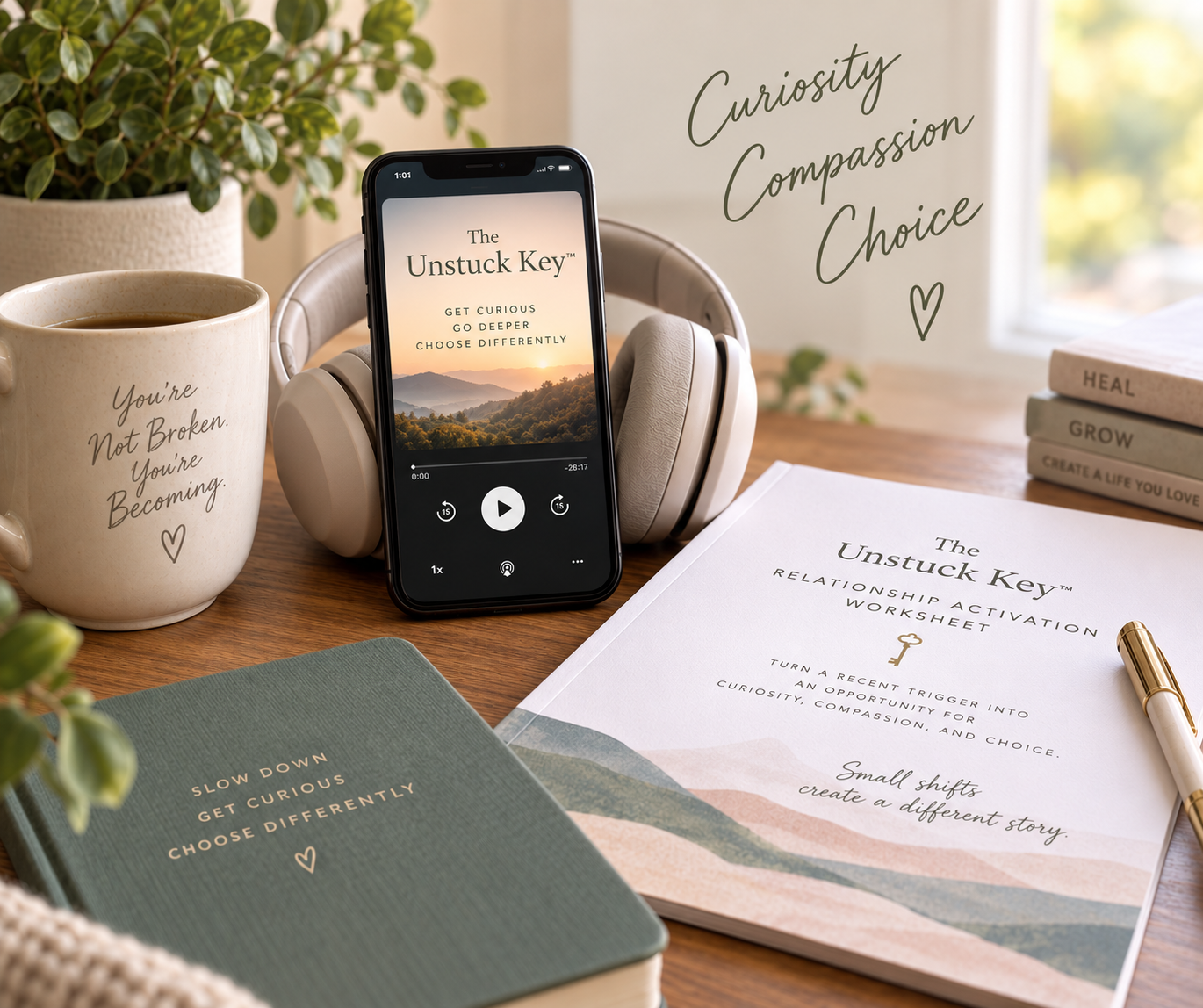
Choose one recent moment and let’s explore it together.
Get free access to The Unstuck Key™ podcast-style audio training and Relationship Activation Worksheet and begin using curiosity, compassion, and choice to understand what may be happening beneath your reactions.
[SUBSCRIBE NOW AND GET THE FREE UNSTUCK KEY™ →]
View The Entire Collection
See all our blog posts to discover valuable insights and tools for navigating trauma and healing with guidance and support.